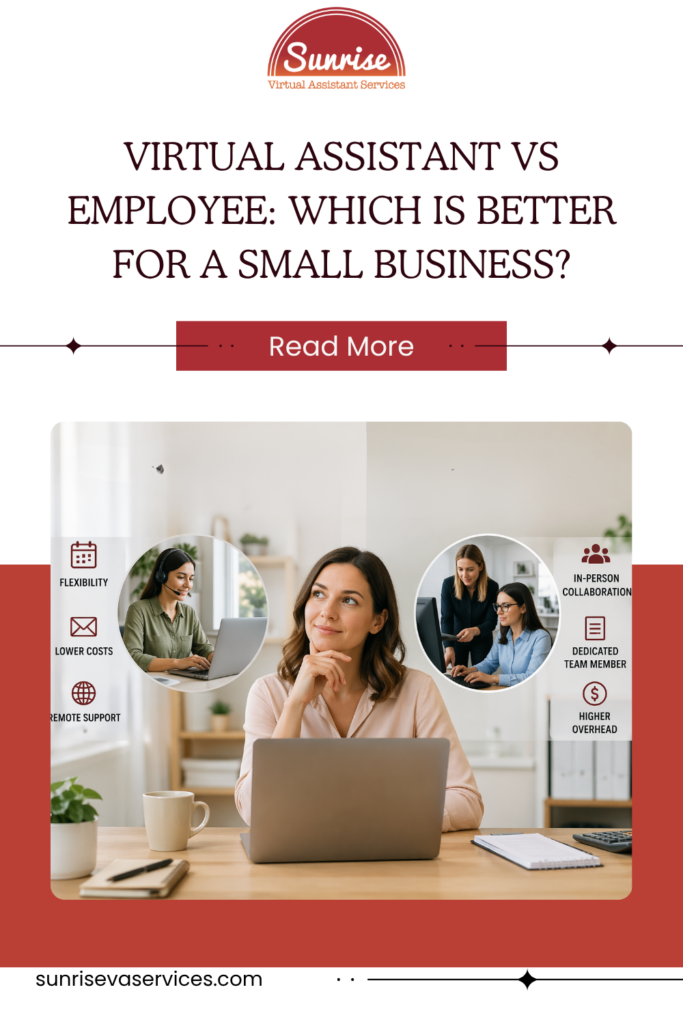

If you are stuck on the virtual assistant vs employee question, you are probably not confused about whether you need help. You are trying to figure out what kind of help makes the most sense for your business right now.
That is an important difference.
A lot of small business owners reach a point where they cannot keep handling every administrative task, customer service request, calendar issue, content update, and backend detail on their own. The business is growing, but so is the workload. At that point, the real question is not whether support would help. It is whether you need a full-time employee, an in-house employee, or a more flexible virtual support setup.
For many small businesses, the answer depends less on status and more on fit. The better choice comes down to your business needs, your budget, the nature of the tasks, and the level of long-term commitment you are actually ready for.
Virtual Assistant vs Employee: What Usually Changes for a Small Business
The biggest difference in the virtual assistant vs employee conversation is not just where the person works. It is how the relationship affects your time, overhead, flexibility, and daily operations.
A traditional employee usually becomes part of your in-house staff or team. That can make sense when you need regular working hours, a physical presence, or someone deeply embedded in company culture and day-to-day operations. A full-time employee may also make more sense as a solution when the role requires ongoing on-site support, face-to-face interaction, or a level of availability that goes beyond specific projects.
In many ways, a virtual assistant, on the other hand, is often a more flexible support model. Many VAs will work remotely as independent contractors or through a service provider, which changes how you think about costs, scheduling, and scope.
But, remember, the IRS says that worker classification depends on the actual business relationship, not just what you call it, which is one reason the structure matters!
That flexibility is often the reason a virtual assistant becomes the better option first.
When a Virtual Assistant Is Usually the Better Choice
A virtual assistant is often the better fit when your business needs help with specific tasks, but not enough to justify the financial commitment of a new hire.
That could include administrative tasks, inbox management, calendar support, data entry, social media management and content creation, customer support, or even just routine backend work that keeps eating up valuable time.
If your workload is real but scattered, a virtual assistant can be a cost-effective solution because you are not necessarily paying for office space, office supplies, payroll taxes, health insurance, retirement plans, or the other additional costs that often come with a W-2 employee.
For a small business owner, that matters.
Sometimes the best option is not to hire someone to sit in the office during regular working hours. Sometimes it is hiring a skilled professional on an as-needed basis to handle the exact work that keeps slowing you down. That is especially true if you need support across varied tasks rather than one narrow in-house role.
This is where Sunrise’s virtual assistant services can make more sense than a full-time hire. If the work you need help with is recurring but flexible, a remote assistant can step in without creating the same operational costs as a traditional employee.
And if you are still trying to decide whether a VA is even worth the money, no one can blame you for having questions.
When an Employee Is Usually the Better Choice
To be fair, a virtual assistant is not always the right answer in every situation.
An employee may be the better choice when you need someone on-site, when the job depends heavily on physical presence, or when the role requires constant integration into your internal workflow. If you need a team member available during fixed work hours every day, or someone whose role depends on in-person collaboration, an in-house employee may be the best fit.
This can also be true when you are filling a position that’s tied closely to company culture, internal management, or any long-term strategic initiatives that require consistent availability and deeper organizational ownership.
In other words, the virtual assistant vs employee decision is not really about which one is universally better. It is about which one matches your current stage of business growth.
If your business truly needs full-time staff, a dedicated on-site employee may be worth the higher financial burden. But if you mostly need help with routine tasks, an employee can become more structured than you actually need.
The Cost Question Small Business Owners Usually Mean
Most business owners asking about a virtual assistant vs an employee are really asking a cost question.
Not just the hourly rate. Total cost.
A virtual assistant often creates cost savings because you are usually paying for support tied to specific roles, projects, or a set monthly amount of help. That makes it easier to scale support up or down based on workload, seasonality, or new priorities.
An employee is usually a bigger long-term commitment. Beyond pay, there may be payroll taxes, employee benefits, health insurance options, pension contributions, training time, equipment, office space, and other overhead costs that do not show up in the initial salary number. The SBA’s hiring guidance for small businesses and its federal small-business compliance resources both reflect that employee management involves more than simply bringing in a new person.
That does not mean employees are a bad investment. It means they are a different kind of investment.
If your business is not ready for that level of fixed cost, a VA is often the more cost-effective alternative.
The Skills Question Matters, Too
Another major factor in the virtual assistant vs employee debate is the kind of skills you actually need.
If you want one person to cover administrative duties, some customer service, light digital marketing support, content creation, and occasional website help, a virtual assistant may give you access to more diverse skill sets than a single in-house administrative employee would.
That is one of the model’s biggest advantages. A good VA can support specific needs without requiring you to build an entire role around a single desk in a single office.
For example, if your biggest pain points are scheduling, inboxes, document cleanup, and follow-through, Sunrise’s administrative support services are already built around that kind of workload. If you mainly need help getting repetitive support tasks off your plate, that is a much better fit than hiring a new employee just because the business feels busy.
And if you are not sure what work should leave your plate first, Sunrise also has a strong companion article on What Tasks Should a Virtual Assistant Handle First?
A Hybrid Approach Can Be the Best Choice
There is also a middle ground that many small business owners overlook.
Sometimes the best choice is neither a virtual assistant nor an employee. It is both, just not at the same time.
A business may start with a VA to take over administrative tasks, customer support, content scheduling, and other time-consuming tasks on an hourly basis. That can create breathing room, improve overall productivity, and make it easier to see what kind of long-term support the business really needs.
Later, if the business grows to the point where it truly needs a full-time employee or on-site role, you can make that move with more clarity.
This hybrid approach is often smarter than rushing into a long-term hire before you know which specific tasks actually justify one.
So, Which Is Better for a Small Business?
For most small businesses, a virtual assistant is often the better first move.
That is especially true when the work is flexible, the support needed spans multiple areas, and the business is not ready to cover the additional expenses of a full-time employee. A VA can be the right choice when you need lower-cost support, faster relief, and help with routine work that is pulling you away from business growth.
An employee becomes the better choice when you need physical presence, fixed availability, deeper in-house integration, or someone to own a role that genuinely requires full-time staff.
So the better choice depends on what kind of help you need now, not what looks more impressive from the outside.
If the business is drowning in admin, communication, backend work, and day-to-day support tasks, the most practical answer isn’t always another traditional employee. It is targeted help that solves the real problem without creating a bigger one.
When Sunrise Makes Sense
If you are asking the virtual assistant vs. employee question because your workload is too big, your time is too fragmented, and you are not ready for the costs of a new hire, Sunrise is here to help.
Sunrise Virtual Assistant Services supports small business owners with flexible, human-first support across admin, content, social media, websites, and other operational needs that don’t always justify an in-house employee but still need to get done.
That means you can get support for the real work on your plate without forcing your business into a staffing model that is heavier than it needs to be.
If that sounds like the right fit, the next step is simple: review Sunrise’s pricing and book a discovery call to talk through the kind of support that would actually help your business move forward.