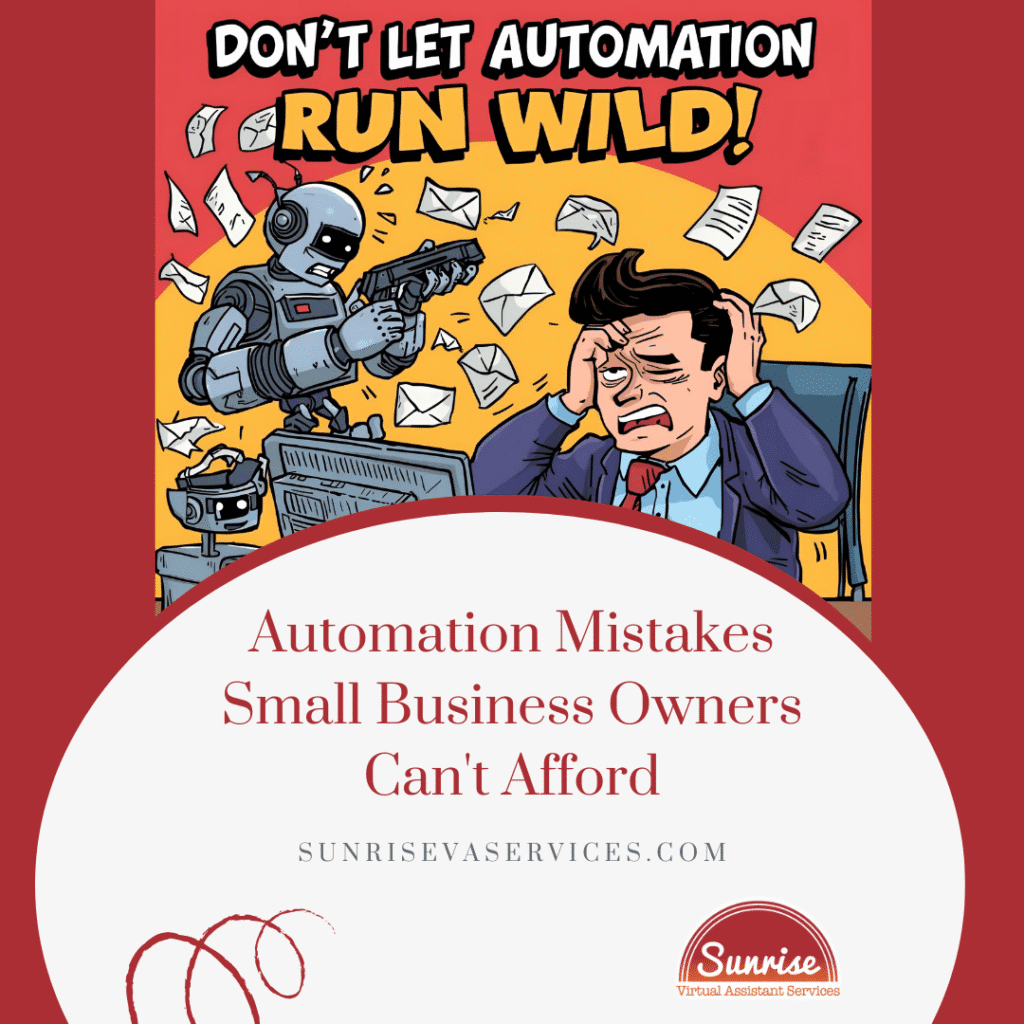
Automation mistakes small business owners make aren’t just embarrassing—they can tank your reputation, your cash flow, and your sanity faster than you can say “Reply All.”
Yeah, automation looks shiny: email campaigns firing off at the right time, social media posts appearing like clockwork, and “workflow automation” promising to save your valuable time.
But here’s the thing: without a human sidekick double-checking the bots, you’re just one misfired campaign away from losing potential customers and getting roasted in the comments section.
And let’s be real—bots and programs don’t care about your business operations. They’re not going to jump in and say, “Hey boss, maybe don’t announce your new products as ‘Now 90% Off!’ when you meant 10%.”
That’s where a virtual assistant swoops in. But before we get to the hero ending, let’s talk about the villains: the most common mistakes small businesses face when relying too much on automation.
Hey, knowledge is power, and we’d be lying if we didn’t admit we use automation tools as well! But if you’re not careful, you too can fall victim to their “set it and forget it” traps.
Automation Mistakes Small Business Owners Make Over and Over
Here’s the irony: you adopted business process automation to escape the black hole of manual tasks and repetitive tasks.
And most of the time, the process works; you’ve set up your campaign, added media elements, scheduled the post, and — bam!—it’s done, right?
But the “automation journey” isn’t just plug-and-play. Without the right automation tools or oversight, you’re setting yourself up for a comedy of errors (minus the laughs).
- Human error still sneaks in. Automations run on the data you give them. Garbage in = garbage out. Mess up your data entry, and suddenly your email campaigns call customers by the wrong name. (“Hey [FirstName]! Buy stuff.”)
- Wrong processes, wrong time. Not every business process should actually be automated. Try automating customer complaints and watch your customer satisfaction sink like a lead balloon. Some things require human empathy – communication being one of them.
- Social media automation backfires. Scheduling tools can make social media platforms run like clockwork, but when every platform gets the same “Happy Friday!” post, your customer engagement feels stale. Or worse—you post a cheerful meme during a global crisis. Yikes.
Automation Is Not a Substitute for Strategy
Too many small businesses face the temptation of “set it and forget it.”
But automation software isn’t magic. It’s a powerful tool, not a crystal ball. Without a key strategy, you’re automating chaos.
Imagine this: your sales team spends weeks prepping a marketing campaign. You trust the software solutions to handle follow-up emails and sales automation tools.
Except… you forgot to tweak the settings. Instead of sending one thoughtful email per lead, your system fires off five in one hour. Congratulations—you’re spam now.
And don’t even get us started on lead scoring. Done right, it’s genius. Done wrong, your potential customers get labeled “cold” when they were about to buy something.
That’s genuine business growth you just threw away, like the winning Wonka bar because the foil wasn’t peeled back enough.
When Automation Efforts Meet Real Life
Let’s talk about the impact of automation when it goes sideways:
- Expense reports sent to the wrong department. Instead of going to finance teams, your IT leaders get them. They’re thrilled.
- Inventory management meltdown. Your small e-commerce store runs a sale, but the automation didn’t sync stock levels. Customers buy products you don’t have. Cue angry customer interactions and poor reviews.
- Cash flow crunch. Automating invoices sounds brilliant—until the dates are wrong and payments get delayed. Your financial processes suffer while you figure out what the bots broke. Oh, and then there are still angry customers, sometimes.
These aren’t hypotheticals. They’re what happens when smaller companies try to copy big corporations with AI tools and large language models, but forget that they don’t have entire it teams babysitting their programs and bots.
Why “Good Automation Tools” Still Need Humans
Even the best part of automation—speed—can become the worst part without some moderation.
Automations never sleep, never get tired, and never stop sending emails at the wrong time. You need actual team members reviewing the process to ensure fewer mistakes and better customer experiences.
Think of automation like a high-powered blender. Great for routine tasks—until you forget to put the lid back on. Then it’s a smoothie apocalypse.
A virtual assistant is the lid. They:
- Check email responses before they go out.
- Make sure marketing automation mistakes don’t hit your customer relationship management system like a virus.
- Keep social media automation fresh, on-brand, and crisis-proof.
- Handle manual processes that should never have been automated in the first place (customer support, anyone?).
How Virtual Assistants Save You From Automation Fails
Let’s face it: business process automation doesn’t replace people—it frees them up to focus on more strategic tasks. But only if you have someone making sure the bots don’t wreck the place.
Here’s what a VA from Sunrise Virtual Assistant Services brings to the table:
- Monitoring Your Email Campaigns
- No more embarrassing typos or wrong links.
- Follow-up emails that feel personal, not robotic.
- Polishing Your Marketing Efforts
- Crafting social media posts with personality.
- Reviewing marketing campaigns before they go live.
- Keeping Your Customer Relationships Human
- Real customer service and customer support responses.
- Protecting customer engagement from being lost in the automation shuffle.
- Streamlining Business Operations
- Catching manual labor tasks that still need a human.
- Making sure workflow automation runs smoothly without derailing.
We’re not saying that Hootsuite and other popular social media automation tools aren’t fantastic.
But they do come with some drawbacks when things don’t work properly, or even if you miss something in your process.
This isn’t about rejecting automation—it’s about achieving successful automation. Smart automation. Automation that works in specific areas, delivering the benefits without turning you, the unsuspecting small business owner, into a cautionary tale.
A second set of human eyes can go a long way when becoming dependent on any type of automation tool; and when mistakes happen, you just might wish you had that second set.
The Bottom Line
Automation is like a katana. Sleek. Deadly. Impressive when you twirl it around. But hand it to someone who doesn’t know what they’re doing?
They’re going to slice their inbox in half and wonder why customers ghosted. And furthermore, why they don’t seem to ever come back.
Small business owners deserve better than letting “smart automation” run wild. You need a sidekick—a human one—to steer your automation initiatives, align them with your business needs, and stop the common automation pitfalls from nuking your brand.
The latest trends in automation strategies aren’t about doing everything with programs and bots. They’re about finding the right processes to automate and the right people to oversee them.
Your Next Step
So, what’s the next step? Don’t waste another hour fixing wrong processes or cleaning up after a bot-tastrophe.
Seriously, it’s not worth your engagement taking a massive hit, and you likely won’t have the time you’ll need to regain traction.
👉 Book a discovery call with Sunrise Virtual Assistant Services today.
We’ll help you figure out which automation software actually fits your unique needs, run your email marketing and social media platforms like pros, and keep your business teams focused on strategic activities instead of putting out fires.
Because automation without a human partner isn’t “set it and forget it.” It’s “set it and regret it.”